



OPINION:
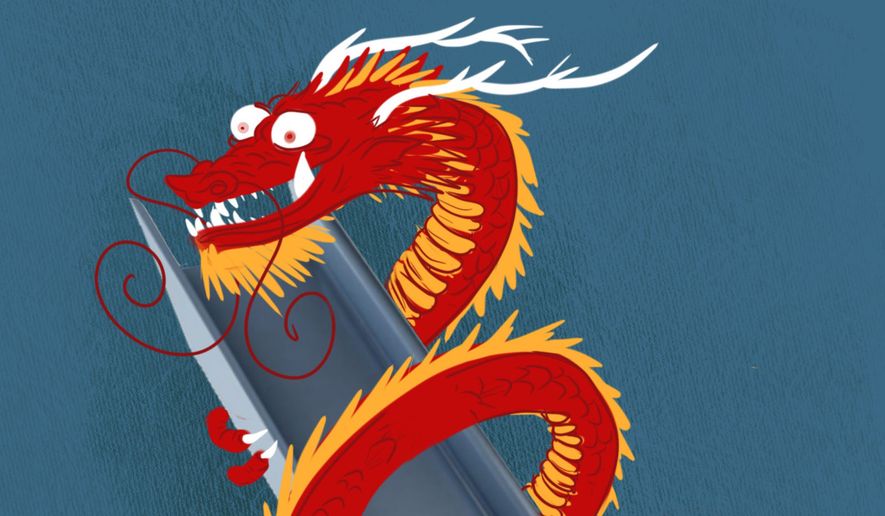
America’s future will not be built with China’s steel.
Following President Trump’s visit to China, we commend his continued commitment to America’s steelmakers by taking on the global scourge of excess capacity, standing firm for fair trade and fighting to bring critical manufacturing jobs and investment back to the United States.
For generations, the steel mills of the American Midwest forged more than beams and bridges. They forged the economic might of the U.S. Then came decades of shuttered plants, hollowed-out towns and a flood of artificially cheap foreign steel that left America dependent on rivals for one of its most strategic industries.
Mr. Trump’s steel tariff upended that trajectory. By directly confronting China’s state-backed overproduction and putting American manufacturing at the center of America First trade policy, his administration helped ignite a long-awaited revival in domestic steelmaking, and with it, renewed hope across the Rust Belt and the rest of the country that America can still build, compete and lead.
From the late 1800s through the middle of the 20th century, America’s industrial heartland — including Indiana, Michigan, Ohio and Pennsylvania — powered the U.S. economy. Known as the Steel Belt, these states formed the backbone of America’s rise into an economic superpower, producing the steel that built our cities, infrastructure, military strength and middle class.
In 1950, the Steel Belt accounted for 43% of total U.S. employment and more than half of all U.S. manufacturing.
But over time, that foundation eroded. Foreign competitors undercut American manufacturers with subsidized production, lower labor standards and unfair trade practices. Factories closed, jobs disappeared overseas and communities that once thrived through manufacturing were left behind.
The Midwest region shed over 1 million manufacturing jobs between 1990 and 2019. The Steel Belt became the Rust Belt, a painful symbol of what happens when industrial capacity is hollowed out and economic opportunity vanishes.
Today, China uses that same playbook to dominate global manufacturing. Through state subsidies, weak environmental standards and forced labor, China produces far more steel than its own economy can consume. The result is a flood of artificially cheap steel that has distorted global markets, crushed prices and undercut manufacturers around the world.
Mr. Trump’s willingness to confront Chinese steel overcapacity head-on is one of the major reasons voters across the Steel Belt supported him. His policies recognized that rebuilding American industry is not just an economic issue, but also a national security issue and a matter of restoring pride and opportunity to working-class communities.
Today, steel manufacturing is experiencing a renaissance across the United States. From Crawfordsville and Butler, Indiana, to Canton and Delta, Ohio, steel communities are seeing renewed investment, stronger production and growing opportunity.
These are the results of policies that put American workers first and push back against those who would rather see U.S. manufacturing decline. America First trade policies helped return the U.S. to its position as the world’s third-largest steel producer for the first time since the 1990s.
Policies like the critical Section 232 steel tariffs have already unleashed more than $25 billion in new investment across the American steel industry and are projected to add 4 million tons of new domestic steelmaking capacity over the next two years alone.
At the same time, the administration’s ongoing Section 301 investigations into global excess capacity and forced labor underscore the scale of the challenge still facing American manufacturers. Over the past decade, the United States imported roughly 200 million metric tons more steel than it exported, a staggering imbalance that threatens the long-term strength of America’s industrial base.
These numbers make one thing clear: Strong trade enforcement is essential to preserving a level playing field for American workers and manufacturers.
A strong steel industry means a stronger America. President Trump can cement a new era of American industrial strength and restore the U.S. as the unrivaled engine of the global economy.
America First trade policies are already helping revive the Steel Belt and reignite manufacturing communities across the country. Sustaining that momentum will require continued resolve against the forces that hollowed out American industry in the first place: unfair trade practices, foreign overcapacity and economic policies that put overseas competitors ahead of American workers.
If the administration stays the course on China, the next chapter of American manufacturing could be one of resurgence and renewed national strength.
• Brandon Farris is executive vice president of the Steel Manufacturers Association.

Please read our comment policy before commenting.